Traffic Master - Jam Buster
Words MobilePuzzle
4.81.37K Reviews
- Version
- 1.20
- Installs
- 500.00K
- Age Rating
- Everyone
Screenshots
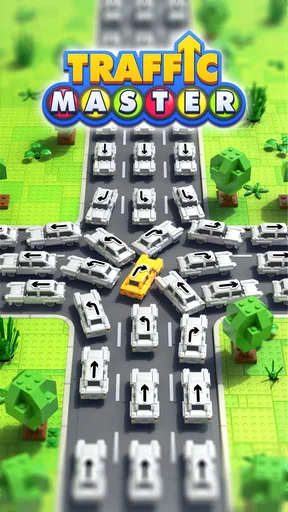
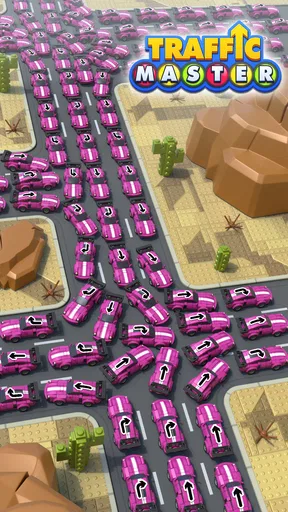
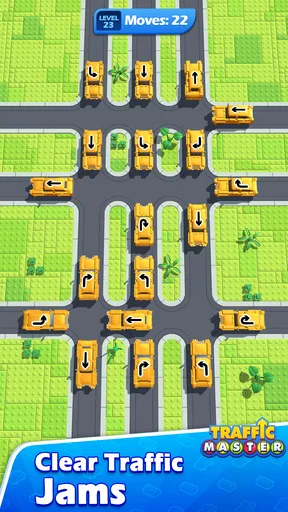
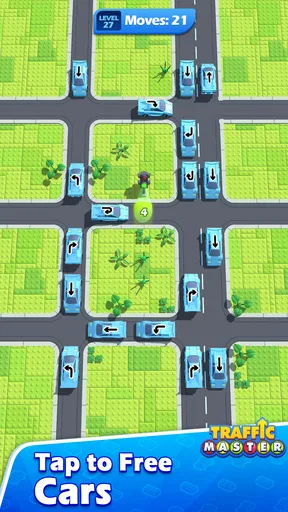
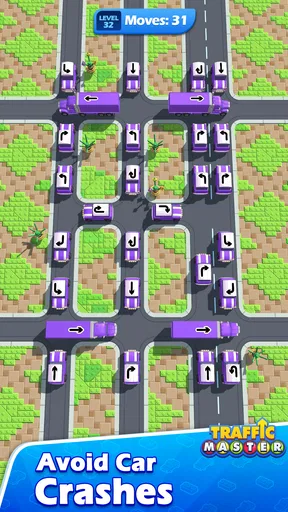
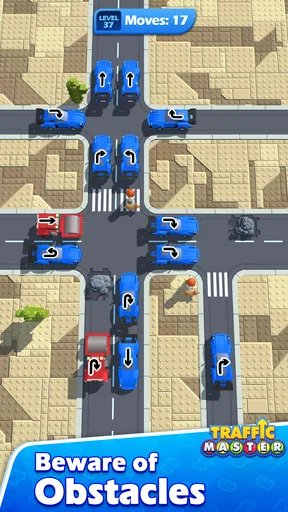
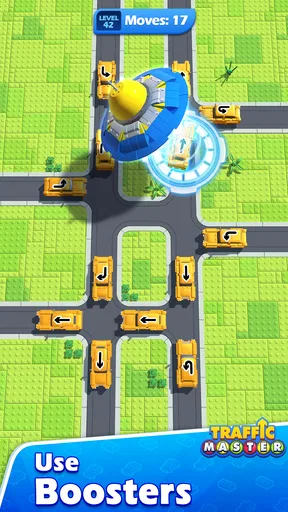
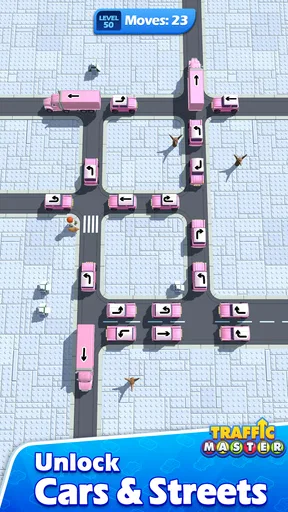
Our Review of Traffic Master - Jam Buster
 Analysis by Appyee
I picked up Traffic Master - Jam Buster expecting a quick puzzle game for spare minutes, and that is exactly where it makes the strongest first impression. The central idea is easy to understand: a road is packed with vehicles, and I tap them in the right order to free the traffic. There is no long tutorial to study and no complicated control scheme to learn. Within moments, I was already testing which vehicle could move safely and which one was blocking the next useful path.
That simplicity is important because the game belongs to the puzzle game category, not to the kind of traffic simulation that asks me to manage signals, routes, fuel, or city planning. I am solving compact visual problems rather than building a transport system. The difference makes it a much better fit for a short break than for someone looking for a deep strategy title.
After spending time with it, my honest view is that the game earns its place mainly through convenience and quick mental engagement. It is free, rated for Everyone, and developed by Words Mobile. The current version is 1.20, and it works on devices running Android 6.0 or later. Those details make it approachable for a broad range of players, including families and people using older phones.
Why the first week feels so satisfying
The opening appeal comes from the fast feedback. I do not need to wait through a long setup before making a meaningful decision. A tap either opens a route or reveals that I have misunderstood the traffic arrangement. That immediate relationship between action and result gives each small level a pleasant rhythm: inspect, predict, tap, and adjust.
The best early sessions are the ones where I stop treating the board like a random pile of cars. Instead, I look for the vehicle that is already aligned with an exit or has the clearest path. Moving that one can expose another route, which then changes the whole puzzle. This makes the game more thoughtful than its one-touch controls suggest. The challenge is not tapping quickly; it is recognizing the order that prevents the road from becoming more tangled.
I found it particularly useful during ordinary waiting situations. A few minutes before an appointment, a short commute break, or a pause while dinner was cooking gave me enough time to complete a handful of puzzles without needing headphones or a large uninterrupted session. The game’s basic interaction is quiet and self-contained, so it does not demand the same attention as an action game.
That said, the first-week charm depends on enjoying repetition. The core activity remains centered on clearing jammed roads. Players who like spatial reasoning and incremental problem solving will probably appreciate that focus. Players who need a story, character progression, or a constantly changing set of mechanics may feel that the initial novelty fades sooner.
One useful habit is to resist the first apparently obvious tap. I often get better results by scanning the edges of the traffic cluster first and identifying vehicles whose movement will not trap another one. This small pause turns the experience from trial and error into a more deliberate puzzle routine. It also reduces the frustration that comes from making a move simply because it looks available.
The game’s average rating of 4.8 from around 34 thousand ratings suggests that its straightforward format has connected with many players. I would not treat that number as a guarantee that every puzzle will suit every person, but it does match my impression of the opening experience: the rules are accessible, the objective is immediately visible, and the first sessions are easy to start.
Learning the board instead of chasing speed
Although the controls are simple, I do not think speed is the main skill. A fast tap made without reading the board can create a worse position, while a slower player can often solve the same arrangement by identifying dependencies. I began asking myself three questions before moving anything: which vehicle has a free route, which vehicle is acting as a blocker, and what space will be available after the move?
This approach is valuable for younger players because it encourages planning without presenting a heavy ruleset. It is also comfortable for adults who want a low-pressure brain exercise. The Everyone rating fits that broad accessibility, though younger children may still benefit from occasional guidance when a puzzle requires looking several moves ahead rather than simply following the most visible opening.
A second practical tip is to use failed moves as information rather than immediately restarting mentally. When a vehicle cannot leave because another one is in the way, that obstruction tells me something about the board’s intended order. I can then work backward from the blocked route. This makes mistakes productive and helps preserve the relaxed feel that suits the game.
What remains useful after the novelty wears off
The harder question is not whether Traffic Master - Jam Buster is enjoyable during the first week. It is whether I still want it installed after the basic surprise has disappeared. For me, its month-to-month value depends on how often I want a compact puzzle rather than on a large amount of content. It works as a reliable fallback when I want to think for a few minutes but do not want to commit to a long session.
The game has a clear recurring use case: mental warm-up. I can play before starting a demanding task, during a short rest, or when I want to replace aimless scrolling with something that asks for modest concentration. The puzzles give my attention a defined target, and the short decision cycle makes it easy to stop after one successful solution.
That benefit is different from what I get from a crossword or a traditional number puzzle. Crosswords depend heavily on vocabulary, while number puzzles can become slow and methodical. This traffic format is more visual and immediate. Compared with a physics-based puzzle, it is also less dependent on experimenting with movement or timing. I am mainly reading positions and planning an order, which makes it easier to play casually.
On the other hand, a dedicated logic-puzzle collection may offer more variety over several months. If I want wordplay, mathematical deduction, or elaborate multi-stage challenges, this title is not a replacement. Its strength is consistency, not a broad menu of puzzle types. I would keep it alongside those alternatives rather than expecting it to cover every kind of mental game.
The game has passed half a million installs, which gives it a substantial audience for a focused puzzle title. I can understand why: it does not ask me to learn a complicated system before providing a challenge. The free price also removes the hesitation that often comes with trying a small casual game. I can install it for occasional use without treating it as a major purchase or a long-term commitment.
Still, free access is not the same as unlimited long-term motivation. My interest rises when I have a specific reason to play, such as filling a short gap or exercising visual planning. It falls when I am looking for a sense of discovery. Once I understand the central traffic-clearing pattern, the game has to rely on the arrangement of each puzzle to keep me engaged. That can be enough for regular light use, but it may not be enough for players seeking constant novelty.
A realistic everyday routine
Imagine having ten minutes before leaving for work. I can open the game, solve a few traffic layouts, and close it without losing an hour to a larger progression system. The same routine works for a student taking a short break or a parent waiting while a child finishes an activity. The important advantage is control over session length: the game fits around the day instead of demanding that the day fit around it.
For that routine, I recommend setting a personal stopping point before starting. I found that the “just one more” feeling is strongest after a puzzle that took several attempts. If I decide in advance to play for a short break, the game remains useful rather than turning into another source of distraction. This is a small but meaningful part of whether it earns lasting space on my phone.
How much upkeep the game demands
Maintenance is one of the game’s better qualities because the basic experience is easy to return to. I do not need to rebuild a complicated strategy after leaving it for a week. When I come back, the visual objective is still clear: examine the packed road and find a safe sequence of taps. That low re-learning cost makes it more practical than puzzle games with elaborate systems that I forget between sessions.
The current version, 1.20, is suitable for devices using Android 6.0 or above. That broad compatibility matters if I am reviewing older hardware or sharing a recommendation with someone who does not replace a phone frequently. I would still make sure the device has enough free space for normal app installation and updates, but the stated operating-system requirement itself is not demanding.
There is also very little behavioral maintenance needed from the player. I do not have to remember daily tasks or preserve a complex build. The game can sit unused and still be understandable when reopened. That makes it a good candidate for a secondary installation: something I keep available for the right moment rather than something I must check every day.
The trade-off is that low maintenance can also mean low attachment. Games built around collections, stories, or evolving personal goals often give me a reason to return even when I am not actively seeking their genre. Here, the return trigger is mostly my own desire for a quick traffic puzzle. If that desire disappears, the app may remain untouched for long periods.
I also think the game is best managed as a short-session tool, not as a primary entertainment platform. Keeping that expectation prevents disappointment. It does not need to compete with a large adventure game or a social title. Its job is smaller and more specific: provide a compact visual challenge with minimal preparation.
Where fatigue can begin
The main source of fatigue is repetition in the central interaction. Clearing vehicles from a crowded road is satisfying when the arrangement makes me reconsider the order of moves. It is less satisfying when several puzzles feel like minor variations on a familiar pattern. Because the rules are intentionally simple, the game has limited room to surprise me without changing the nature of the experience.
I also noticed a potential tension between accessibility and depth. The easy-to-understand controls are one of the reasons I can recommend the game to casual players, but they also mean that experienced puzzle fans may want more layers. Someone who enjoys complex deduction, long planning chains, or unusual rule combinations could find the traffic concept too narrow after extended play.
The game is not the right choice for a player who wants a competitive leaderboard, a narrative reason to continue, or a strong sense of personal customization. It is also not ideal for someone who dislikes retrying a layout after a mistaken move. The pleasure comes from observing, planning, and correcting, so players who want every action to succeed immediately may experience the learning process as friction rather than fun.
Another limitation is that its usefulness depends on my mood. When I am mentally tired, a compact puzzle can be refreshing, but a difficult traffic arrangement can also feel like extra work. In those moments, a passive game or a simple arcade experience may be a better fit. Traffic Master - Jam Buster asks for attention even though it does not ask for much time.
My best way to reduce fatigue is to change how I approach each session. Instead of rushing through as many boards as possible, I treat a single puzzle as a small planning exercise. I look for the first safe release, then reassess the new space rather than following a fixed pattern. This keeps the activity more deliberate and makes familiar layouts less automatic.
Who should choose another puzzle instead
If I were recommending a game to someone who loves word clues, I would point them toward a word puzzle rather than this one. If they prefer numbers and exact deduction, a number-based logic game may provide more sustained depth. If they want physical experimentation, a physics puzzler will probably offer richer interaction. This title is strongest for people who enjoy visual ordering problems and want them in a clean, approachable format.
It is also worth skipping if the player needs a game that rewards long-term mastery through many distinct systems. The traffic concept can be engaging, but it should be chosen for its focused loop, not for promises of broad genre variety. In my experience, knowing that limitation beforehand makes the game more enjoyable because I am judging it by the right standard.
My long-term verdict
After the first-week excitement fades, Traffic Master - Jam Buster remains useful as a dependable short-session puzzle, but it does not become an essential daily habit for me. Its lasting value comes from frictionless access, clear visual planning, and the ability to fit into small gaps in a normal day. I can return after time away and understand what I am doing immediately.
I recommend it to casual puzzle players, families looking for an Everyone-rated option, and anyone who likes solving traffic arrangements through careful sequencing. The free price makes trying it easy, and the broad Android compatibility helps it reach devices that may not handle newer games comfortably. Words Mobile has kept the concept focused enough that the first few sessions require almost no explanation.
My recommendation is more cautious for dedicated puzzle enthusiasts. If you need a constantly expanding challenge or several distinct mechanics, the narrow traffic-clearing format may not hold your attention for months. A broader puzzle collection will probably serve you better. Even so, this game can still work as a lighter companion for moments when a crossword feels too demanding and an arcade game feels too noisy.
The most important decision is whether you value a game that is easy to maintain over one that constantly pulls you back. I prefer using this one intentionally: open it when I want a brief planning exercise, play with patience, and stop before the repetition becomes tiring. Used that way, it earns a modest but genuine place on my device.
My final judgment is positive, with realistic expectations. This is not a deep strategy experience disguised as a casual game, and it does not need to be. It is a focused puzzle built around freeing crowded roads, and its strongest quality is how quickly it turns an empty few minutes into a small problem worth solving. Its lasting appeal is practical rather than dramatic: when I want a simple visual challenge without preparation, it is an easy game to reach for.
Verdict
Strengths of Traffic Master - Jam Buster
- Simple tap controls make the game easy to learn quickly.
- Short levels are ideal for quick breaks or casual play.
- Traffic puzzles offer a satisfying sense of progression.
- Bright visuals make vehicles and road layouts easy to distinguish.
- Increasing difficulty keeps later stages more engaging.
Limitations of Traffic Master - Jam Buster
- Some puzzles may feel repetitive after extended play sessions.
- Mistakes can be frustrating when traffic patterns become crowded.
- Progress may feel slow if later levels require repeated attempts.
- Small visual details can be harder to read on compact screens.
- The game offers limited appeal for players seeking deep strategy.
Other Releases by Words Mobile
View All
Crossword Quest
Word4.7

Ball Sort Game - Color Puzzle
Puzzle4.9
Similar Picks in This Category
View All
Block Blast!
HungryStudio4.8

Braindom: Brain Games Test
Lahana Game Studio4.6

AMAZE!
CrazyLabs LTD4.6

Sudoku - Classic Sudoku Puzzle
Oakever Games4.7

Art Puzzle - Puzzle Games
Easybrain4.8

Amaze GO!
Oakever Games4.9
Frequently Asked Questions
What is Traffic Master - Jam Buster?
Traffic Master - Jam Buster is a casual puzzle game focused on clearing crowded traffic situations. You typically need to move vehicles in the correct order, open paths, and prevent cars from blocking one another. The concept is easy to understand, but later stages require more careful planning, timing, and attention. It is designed for short play sessions and progressively more challenging traffic puzzles.
How do you play Traffic Master - Jam Buster?
Gameplay generally involves tapping or directing vehicles so they can leave a congested area without colliding or creating additional obstacles. Before making a move, it is important to examine the available routes and identify which vehicle should go first. Some levels may introduce tighter spaces, special obstacles, or increasingly complex traffic patterns, so rushing can quickly lead to mistakes.
Is Traffic Master - Jam Buster free to download and play?
Traffic Master - Jam Buster can usually be downloaded for free, although the game may include optional advertisements, in-app purchases, or both. Ads may appear between levels or when you choose bonus rewards, while purchases can potentially provide extra resources or remove advertising. Check the Google Play Store or App Store listing for the current pricing and purchase details before installing.
Can Traffic Master - Jam Buster be played offline?
Many of the main puzzle levels may be playable without a constant internet connection, which makes the game suitable for commuting or other situations without reliable Wi-Fi. However, features such as advertisements, cloud synchronization, leaderboards, events, or purchases may require internet access. Availability can vary by version, so it is best to test offline play after the initial installation.
Is Traffic Master - Jam Buster suitable for children and casual players?
The simple controls and colorful traffic-puzzle format make Traffic Master - Jam Buster accessible to casual players and older children. Nevertheless, difficulty can increase as levels progress, and advertisements or optional purchases may be present. Parents should review the store’s age rating, privacy information, and purchase settings, especially if the game will be installed on a child’s device.
Play our best games!


